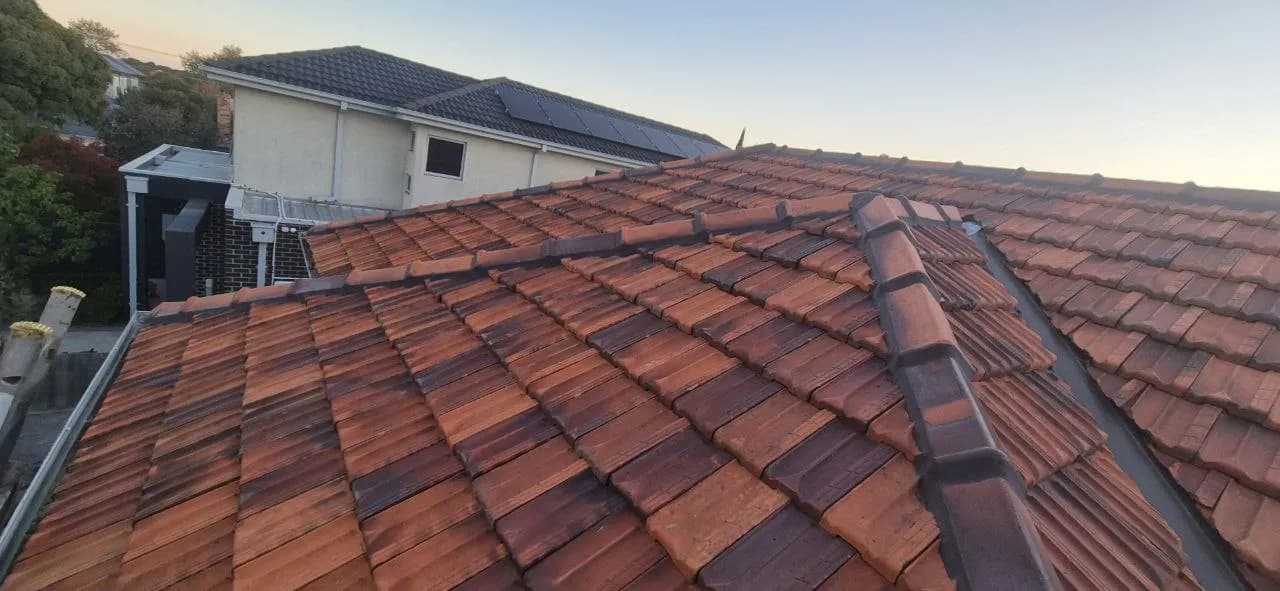
Trees, Leaf Litter and Your Roof: Keeping Gutters Healthy on the Mornington Peninsula

Trees are the single biggest outside cause of blocked gutters we see on the Mornington Peninsula. A house under gums, pines or a big liquidambar can fill its gutters in a few weeks, and once water starts backing up, the damage moves from the gutter to the fascia, the eaves and eventually the ceiling. The fix is not cutting the trees down. It is knowing which trees cause what, cleaning on a schedule that matches your block, and fitting the right guard where it earns its keep.
This guide covers how leaf litter actually damages a roof, the local tree species that cause the most trouble, how often gutters need cleaning under heavy cover, and when gutter guard, valley guard or tree work is the better investment.
How Leaf Litter Damages a Roof, Not Just the Gutter
A gutter full of leaves is easy to dismiss. What happens next is not.
- <strong>Weight and sag.</strong> Wet leaf sludge is heavy. Brackets are designed to hold a gutter and flowing water, not a trough of compost. Over a season or two the gutter sags, loses its fall and starts holding water even after it stops raining.
- <strong>Overflow at the back.</strong> When the gutter is full, water does not only spill over the front. It runs back over the rear lip onto the fascia and into the eaves, which is how a blocked gutter turns into a ceiling stain in the room below.
- <strong>Fascia rot.</strong> Timber fascia that stays damp behind a sludge-filled gutter softens and rots. Eventually the gutter screws have nothing to bite into and the gutter pulls away.
- <strong>Blocked valleys.</strong> Leaves collect in the valleys between roof sections before they ever reach the gutter. A blocked valley sends water sideways under the tiles, and valley leaks are among the most common we find on tree-covered blocks.
- <strong>Moss and lichen.</strong> Shade keeps tiles damp, and damp tiles grow moss and lichen that make concrete tiles porous over time.
- <strong>Rust.</strong> Decomposing leaves hold moisture against the steel and release mild acids. Combine that with salt air and the base of the gutter can rust through while the top edge still looks fine from the ground.
- <strong>Fire risk.</strong> Dry gum leaves in a gutter are kindling for embers. In the Peninsula hinterland and leafy parts of Mount Eliza and Frankston South, a late-spring clean is a fire-safety job as much as a drainage one.
We go through the mechanics of the leak itself in <a href="/blog/clogged-gutters-cause-roof-leaks">Can clogged gutters cause roof leaks?</a> The short answer is yes, and usually without any visible damage to the roof.
The Trees That Cause the Most Trouble on the Peninsula
Every tree sheds, but some shed in ways that defeat gutters. These are the ones we clean up after most often.
Gum Trees (Eucalypts)
The default tree in Langwarrin, Seaford, Baxter and most of the hinterland. Gums drop all year round, with peaks in summer heat. The long, narrow leaves travel a long way on the wind, slide straight into downpipe outlets and slip through cheap mesh. They also drop bark, gumnuts and branches heavy enough to crack a tile or dent a sheet. The oily leaves break down slowly and stain fascias as they do.
Pines and Sheoaks
Old radiata pines line many older Peninsula properties, and sheoaks are native along the Seaford and Frankston foreshore. Both drop fine needles that weave into a dense mat. The mat acts like a sponge, holding water against the gutter floor for weeks, and the needles are acidic as they rot. Pine needles are the fastest way we know to rust out the base of a steel gutter, and they get through most standard gutter guards.
Liquidambars and Plane Trees
Popular in established streets in Frankston, Mornington and Mount Martha for their autumn colour. Liquidambars drop a heavy load of broad leaves over a few weeks, plus spiky seed balls that are exactly the right size to lodge in a downpipe outlet. Plane trees shed large leaves and a fine fuzz that turns to paste in water and sticks in gutter corners.
Paperbarks and Tea-Tree
Common near the coast. Peeling paperbark lays over outlets like papier-mache, and the tiny blossoms turn into a compost-like muck that blocks valleys as readily as gutters.
Council Street Trees
Brush box and similar hardy species planted on nature strips drop tough, leathery leaves that suction onto wet surfaces and clump into small dams. Because they are council trees you cannot prune them yourself, so guard and regular cleaning are the practical answers.
Where We See It Most
The pattern follows the tree cover. Mount Eliza, Frankston South and Mount Martha have mature gardens with big established gums and conifers right over the roofline. Langwarrin, Baxter and Somerville sit in bush corridors with gums on most blocks. Seaford and the Frankston foreshore add sheoaks, tea-tree and wind-blown sand to the mix, which makes a heavy, slow-moving sludge that is hard on gutters. Further north in the City of Casey, newer estates have smaller trees but often more liquidambars and ornamental pears.
You do not need a tree in your own yard to have the problem. Bay winds carry leaves from a neighbour’s gum or a nearby reserve onto any roof in their path.
Salt Air and Leaf Litter Together
Inland, a gutter full of leaves rusts slowly. Near the bay it rusts quickly, because salt settles on the steel and the wet leaf mat traps it against the metal around the clock. The result is a gutter that looks sound from the ground and has a lace-work base underneath the sludge. If your home is anywhere between Carrum Downs and Mornington and has trees nearby, treat gutter cleaning as rust prevention, not just drainage.
How Often Should Gutters Be Cleaned Under Trees?
Our standard advice is at least twice a year: autumn (April–May) after the main leaf fall and spring (September–October) before the heavy rain. Under trees, that is the minimum, not the target.
- <strong>Light tree cover, no overhanging branches:</strong> twice a year.
- <strong>Gums, pines or a large deciduous tree within reach of the roof:</strong> every three months, or at least a third clean in late spring before fire season.
- <strong>Pine needles or sheoak litter:</strong> quarterly, with a downpipe flush each time. Needles block outlets before the gutter looks full.
- <strong>After any big storm:</strong> a quick check from the ground, and a clean if water is spilling over anywhere.
The autumn clean is the one most people remember. The late-spring clean is the one most people skip, and it matters more on the Peninsula: it clears dry litter before the ember season and before summer downpours. Our <a href="/blog/winter-roof-maintenance-guide-peninsula">winter roof maintenance guide</a> covers the autumn side of the calendar in detail.
💡 Pro Tip: <strong>Grass growing in the gutter</strong> means the sludge has been there long enough to become soil, and that gutter has been holding water for months. Book a clean and ask for photos of the gutter floor once it is clear, so you know whether rust has started.
Gutter Guards: When They Are Worth It
Gutter guard is the question we are asked most on tree-covered blocks. The honest answer depends on the product and the tree.
- <strong>Hardware-store plastic mesh:</strong> avoid it. It curls and breaks down in the sun within a couple of seasons, then falls into the gutter and becomes the blockage.
- <strong>Professionally fitted steel or aluminium mesh:</strong> works well against gum leaves, liquidambar leaves and seed balls, and keeps birds and possums out. Choose a powder-coated product matched to the roof and, in bushfire-prone areas, an ember-rated one.
- <strong>Mesh aperture matters:</strong> fine enough to stop needles, open enough that water does not sheet over the top in a downpour. Pine and sheoak needles defeat coarse mesh.
- <strong>It reduces cleaning, it does not end it:</strong> fine silt and blossom still build up under the mesh, so plan a flush every year or two.
On a block under big gums, good guard usually pays for itself in avoided cleaning and avoided rust. On a block with one deciduous tree, twice-yearly cleaning is cheaper. We measure and tell you which applies. See <a href="/services/gutter-guard-installation">gutter guard installation</a> for the products we fit, and <a href="/services/valley-guard-installation">valley guard</a> for roofs where the valleys block before the gutters do.
Managing the Trees Themselves
We are roofers, not arborists, but the same advice comes up on most jobs:
- <strong>Clearance from the roofline.</strong> Keeping branches two to three metres clear of the roof cuts direct leaf drop, stops branches scraping tiles in wind and removes the possum highway into the roof space.
- <strong>Check before you cut.</strong> Frankston City and Mornington Peninsula Shire both have local laws protecting certain native and significant trees. Ask the council before any major pruning or removal.
- <strong>Prune in the right season.</strong> A late-winter prune means less litter through spring and summer.
- <strong>Mind the valleys.</strong> If a branch sits over a valley, that valley will block first. Prioritise that branch.
Why Not to Clean Them Yourself
Most Peninsula blocks are not flat, and a ladder on a sloping driveway or soft garden bed is where gutter cleaning injuries start. Leaning out for one more handful is the other. Wet tiles and mossy roofs are slippery, and walking on the wrong part of a tile cracks it.
⚠️ Safety Warning: Falls from ladders and roofs are a leading cause of serious injury in Victoria. If your gutters are above single-storey height, the ground is uneven, or the roof is wet or mossy, stay off and call someone with harnesses and roof anchors.
A professional clean on a tree-covered block is also more than scooping leaves. Our <a href="/services/gutter-cleaning">gutter cleaning</a> includes hand clearing, a downpipe flush to confirm every outlet runs, a look at valleys, flashings and the gutter floor for early rust, and before-and-after photos so you can see the result without climbing. Pricing starts from $150 for a straightforward single-storey home; heavily blocked or double-storey gutters take longer and are quoted after a look. If you would rather not think about it, <a href="/services/gutter-maintenance">scheduled gutter maintenance</a> books the autumn and spring cleans for you.
When Leaf Damage Has Already Gone Further
Sometimes we arrive for a clean and find the problem is past cleaning:
- <strong>Rusted-through gutters</strong> need replacing. Our <a href="/blog/gutter-replacement-cost-frankston-peninsula">2026 gutter and downpipe replacement cost guide</a> explains what to budget.
- <strong>Soft fascia</strong> is repaired or capped before new gutters go on.
- <strong>Rusted valley irons</strong> are replaced, ideally with valley guard fitted at the same time.
- <strong>Moss and lichen across the tiles</strong> is a <a href="/services/roof-cleaning">roof clean</a> job, and on an older roof often the first step of a restoration.
None of this is a reason to panic. It is a reason to get the gutters looked at before winter rather than after the first ceiling stain.
Book a Gutter Clean or Inspection
We are based in Narre Warren and have been cleaning, repairing and replacing gutters across Frankston, the Mornington Peninsula and the City of Casey since 2010. Mike looks at the roof as well as the gutters on every visit, so you hear about a cracked tile or a rusting valley while it is still a small job.
Gutters under trees? Call Mike on 0437 641 027 or request a free quote online. Tell us the suburb, the type of trees and whether the house is single or double storey, and we will recommend a cleaning schedule, guard or both.
Related Services
Serving Frankston, Mornington Peninsula & South-East Melbourne
We provide expert roofing services across these suburbs and surrounding areas. Click your suburb for local information and a free quote.
Frequently Asked Questions
How often should gutters be cleaned if I have gum trees?
Every three months is a safe schedule under gums, or at the very least three times a year: autumn, late spring before fire season, and once over summer. Gums drop all year, so twice a year usually is not enough. Flushing the downpipes each time matters as much as clearing the trough.
Do gutter guards stop gum leaves?
Good steel or aluminium mesh, fitted properly, stops most gum leaves and keeps nuts and bark out. Fine pine and sheoak needles are harder to stop and need a finer aperture. Plastic roll mesh from the hardware store does not last in the sun and we recommend against it. Any guard still needs a flush every year or two to clear silt.
Can leaves in the gutter really cause a roof leak?
Yes. When a gutter is full, water backs up over the rear lip into the eaves and roof space, and leaves that collect in valleys send water sideways under the tiles. Both cause ceiling stains with no visible damage to the roof itself. Clearing gutters and valleys is the first thing we check on any tree-covered leak call.
Should I remove the tree?
Rarely. Clearance pruning two to three metres back from the roofline, good gutter guard and a realistic cleaning schedule solve most cases and keep the shade and value the tree adds. Check with your council before major pruning or removal, as many Peninsula trees are protected under local laws.
Does gutter cleaning cost more if the gutters are badly blocked?
It can. Cleaning starts from $150 for a straightforward single-storey home, and a gutter that has not been touched for years, or a double-storey home, takes longer and needs more equipment. The figure is indicative for Melbourne’s south-east and confirmed on inspection. Regular cleans are cheaper per visit than one big rescue job.
Need Help With Your Roof?
Get a free, no-obligation inspection and quote. We'll give you honest advice — even if that means telling you it just needs minor repairs.